
H₂ Water in Sports: Lactate, Muscle Soreness & Evidence
Several studies show lower blood lactate. Findings on muscle soreness and endurance are inconsistent – here we explain the research and its limits.


Anyone who regularly pushes their limits in training knows the price of athletic success: burning muscles during the workout, leaden exhaustion afterwards and days when you can barely get down the stairs because of muscle soreness. Muscular fatigue from intense exertion and the so-called DOMS (Delayed Onset Muscle Soreness) are widely considered unavoidable companions in competitive sport.
However, in recent years a new, completely legal and scientifically founded "secret weapon" has established itself in the locker rooms of elite athletes: hydrogen water (H₂ water).
What role might H₂ water play in sport? This report covers lower blood lactate findings, possible recovery support and the inconsistent evidence on muscle soreness and endurance.
What exactly is hydrogen water (H₂ water)?
Hydrogen water is simply normal drinking water (H₂O) into which additional gaseous, molecular hydrogen (H₂) has been infused.
Smallest Molecular Size
Hydrogen is the smallest and lightest molecule in the universe. It effortlessly penetrates all cell membranes, the blood-brain barrier and even the mitochondria – the power plants of our cells.
Highly Selective Antioxidant
H₂ can specifically neutralize cell-toxic free radicals such as the hydroxyl radical, which are produced in large quantities during intense sport. At the same time, it leaves the radicals important for muscle building completely intact.
Regenerative & Balancing
Through its antioxidant properties, H₂ can promote natural recovery after training and support the regeneration of strained muscle tissue.
The Fight Against Lactate: How H₂ Water Can Reduce Fatigue
To understand why H₂ water is so effective, we need to look at what happens in the body during intense training:
Under high load (anaerobic training such as sprints, HIIT or heavy strength training), the energy demand of the muscle cells rises rapidly. The body resorts to anaerobic glycolysis – lactate is produced as a byproduct. At the same time, protons (H⁺ ions) are released during the splitting of ATP, which lower the pH value in the muscle cell. The result: an acute drop in performance, rapid fatigue and the typical muscle burning.

Accelerated Lactate Clearance at the Cellular Level
Scientific studies on elite athletes prove that drinking H₂ water before and during training can significantly reduce lactate accumulation in the blood.
H₂ acts at the cellular level: by reducing oxidative stress in the mitochondria – the power plants of our cells – cellular energy production (ATP synthesis) can run more efficiently. The body can thus transport and metabolize the formed lactate much faster. Athletes can delay their fatigue threshold and perform longer at a high intensity level.

Muscle Soreness in Focus: An Inconsistent Evidence Base
Every athlete knows it: the Delayed Onset Muscle Soreness (DOMS) – the delayed muscle soreness that is usually most noticeable 24 to 72 hours after training. DOMS is caused by tiny micro-tears (microtraumas) in the muscle fibers that lead to a natural adaptation reaction of the body.
These processes are further fueled by the oxidative stress that occurs during sport. Free radicals attack the muscle tissue strained by training and can prolong the recovery time.
Support Through Molecular Hydrogen
Since H₂ water has a strong antioxidant effect, it can proactively intervene in these stressful processes. It can intercept the harmful radicals before they further burden the surrounding muscle tissue, and support the body's natural recovery reaction to the microtraumas.
The evidence on muscle soreness is inconsistent: individual studies report less soreness, while Zhou et al. (2024) found no accelerated recovery from muscle soreness. A general effect cannot be inferred from the current evidence.
Practical Tip: How to Use Hydrogen Water for Your Training
In professional sport, milliseconds count. To explore possible effects on lactate and recovery, H₂ water is often used around training. Findings on muscle soreness and endurance remain inconsistent:
Pre-Workout (30 min before)
Drink approx. 250-500 ml of highly dosed H₂ water. It prepares the cells, buffers upcoming lactate and increases fatigue resistance.
Post-Workout (Directly after)
Drink another portion (250-500 ml) to support recovery. An effect on muscle soreness is not established by the current inconsistent evidence.
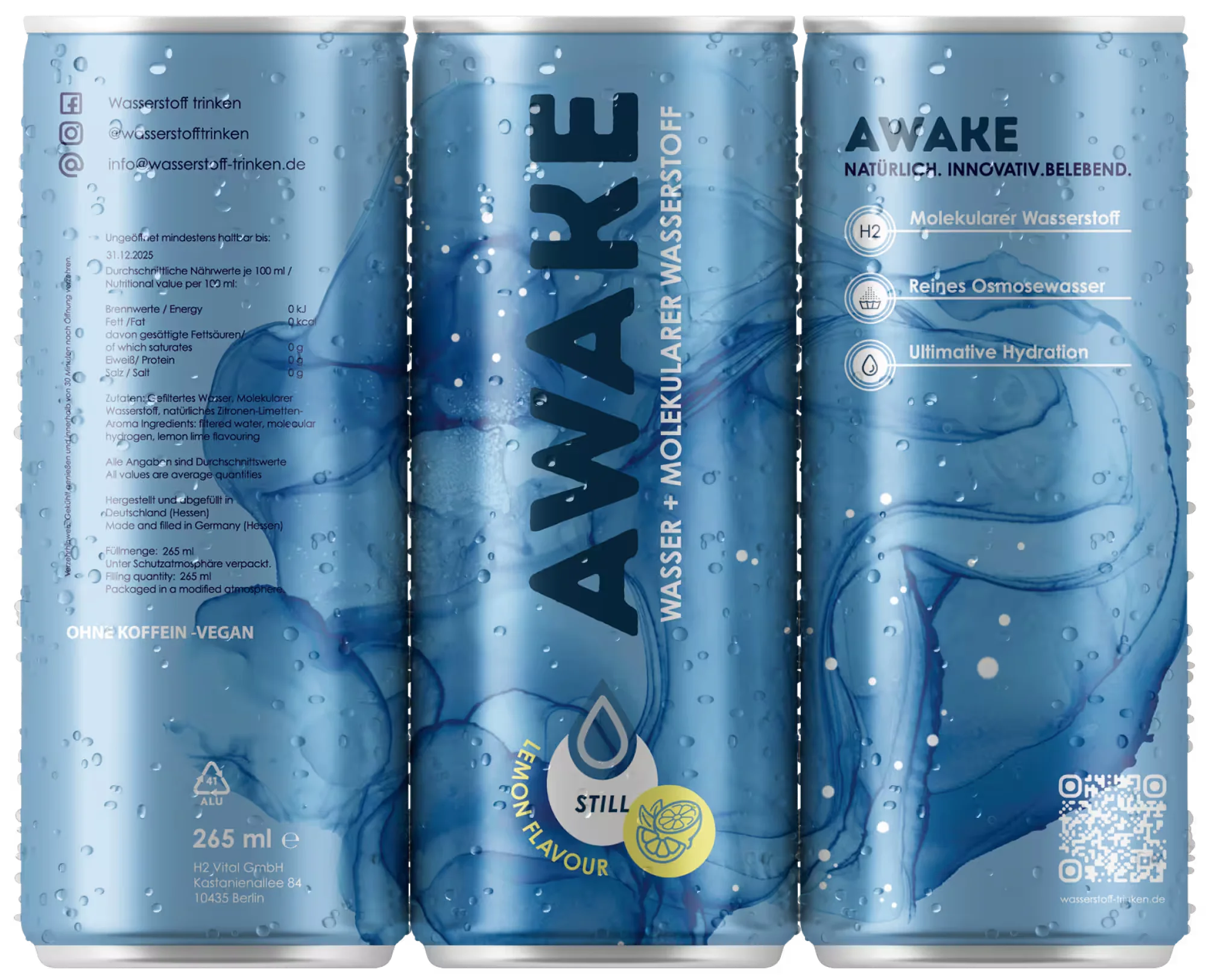
Note: Since H₂ gas is very volatile, the water should ideally be consumed fresh. AWAKE delivers up to 11 ppm pure molecular hydrogen in airtight sealed cans and bottles – so the H₂ remains optimally preserved.
Frequently Asked Questions (FAQ)
The evidence is inconsistent: individual studies report less muscle soreness, while Zhou et al. (2024) found no accelerated recovery from muscle soreness. A clear reduction in DOMS cannot therefore be generalized.
Ideally, you drink 300-500 ml H₂ water 30-60 minutes before training to prepare the cells. Directly after training follows another portion to initiate recovery and neutralize oxidative stress.
Yes, molecular hydrogen is not a doping agent and is not on the WADA prohibited list. It is a 100% natural element that the body also produces itself. H₂ water is calorie-free, sugar-free and free from artificial additives.
During intense exertion, lactate is produced as a metabolic byproduct of anaerobic energy production. At the same time, protons are released that lower the pH value in the muscle cell and contribute to fatigue. H₂ water acts at the cellular level: by reducing oxidative stress in the mitochondria – the power plants of our cells – the efficiency of energy production improves, allowing the body to transport and metabolize lactate faster. Scientific studies prove a significant reduction in blood lactate after training.
Many athletes report more endurance and later fatigue. By reducing oxidative stress, the mitochondria work more efficiently and can provide more ATP (cellular energy) – which can be reflected in higher performance.
For optimal results, 2-3 portions of H₂ water daily are recommended – one before, optionally one during and one directly after training. On rest days, one portion is sufficient to supply the body with molecular hydrogen.
Conclusion: Natural Support for Performance & Recovery
Hydrogen water is a calorie-free lifestyle beverage and WADA-compliant. Several studies report lower blood lactate, while findings on muscle soreness and endurance remain inconsistent.
Molecular hydrogen may be part of an individual training routine, but it does not replace balanced recovery or medical advice.
Experience the
AWAKE Effect
AWAKE – the hydrogen drink with up to 11 ppm, without caffeine, without sugar.
- Up to 11 ppm hydrogen concentration via nanobubble technology
- Without caffeine, without sugar, 100% pure
- In glass & can – no PET, maximum stability
- No chemical additives
Evidence context
Findings on muscle soreness and endurance are inconsistent. Several studies show lower blood lactate, a meta-analysis found no significant effect on endurance, and one study found no accelerated recovery from muscle soreness.
Scientific Sources
The sports medicine statements in this report are based on peer-reviewed, clinical studies:
- Aoki, K., Nakao, A., Adachi, T., Matsui, Y., & Miyakawa, S. (2012). Pilot study: Effects of drinking hydrogen-rich water on muscle fatigue caused by acute exercise in elite athletes.. Medical Gas Research, 2(1), 12..
- Botek, M., Krejci, J., McKune, A. J., Sladeckova, B., & Naumovski, N. (2019). Hydrogen Rich Water Improved Ventilatory, Perceptual and Lactate Responses to Exercise.. International Journal of Sports Medicine, 40(14), 879-885..
- Mikami, T., Tano, K., Lee, H., Park, J., Ohta, S., & Ito, M. (2019). Drinking hydrogen water enhances endurance and relieves psychometric fatigue: a randomized, double-blind, placebo-controlled study.. Canadian Journal of Physiology and Pharmacology, 97(9), 857-862..
- Ostojic, S. M. (2014). Molecular hydrogen in sports medicine: new therapeutic perspectives.. International Journal of Sports Medicine, 35(12), 973-979..
- Ohsawa, I., Ishikawa, M., Takahashi, K., et al. (2007). Hydrogen acts as a therapeutic antioxidant by selectively reducing cytotoxic oxygen radicals.. Nature Medicine, 13(6), 688-694..
The statements made in this article are for informational purposes only. Hydrogen water is a lifestyle beverage and not a medicinal product. It does not promise a cure and is not intended to diagnose, alleviate or treat diseases. For health questions, always consult a doctor.