
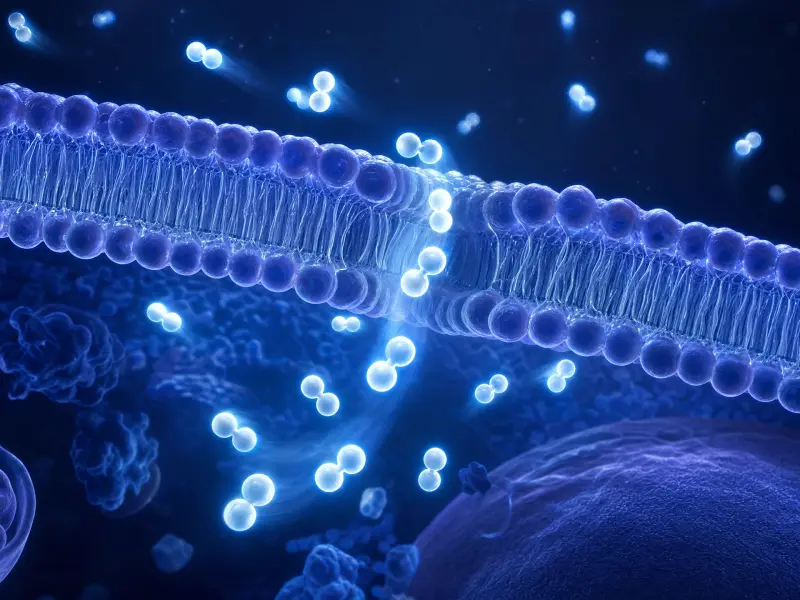
Molekularer Wasserstoff (H₂) durchdringt die Zellmembran

Hydrogen as an antioxidant: why molecular hydrogen (H₂) acts selectively

Why does molecular hydrogen react only with the most aggressive free radicals? A look at the chemistry of selectivity, the 2007 Nature Medicine study and the current state of research.

Published on July 2, 2026Last updated: July 15, 2026

Antioxidants are a perennial topic – vitamin C, vitamin E, polyphenols from berries, resveratrol from red wine. The market is large and the industry’s promise is usually the same: capture free radicals, support cells, counteract ageing. It becomes interesting when you look more closely at the underlying principle of many classic antioxidants – and at a molecule that researchers have been studying intensively for around two decades.

Molecular hydrogen (H₂) is the smallest and lightest molecule in the universe. At the same time, it is one of the most scientifically discussed candidates in antioxidant research. The reason can be summed up in a single word: selectivity. This article explains what that means chemically and why researchers find it so compelling.

Note: This article is a scientific, informational overview of the research on molecular hydrogen. It describes mechanisms and study results from basic research and expressly does not constitute health, efficacy or therapeutic claims for any individual product.
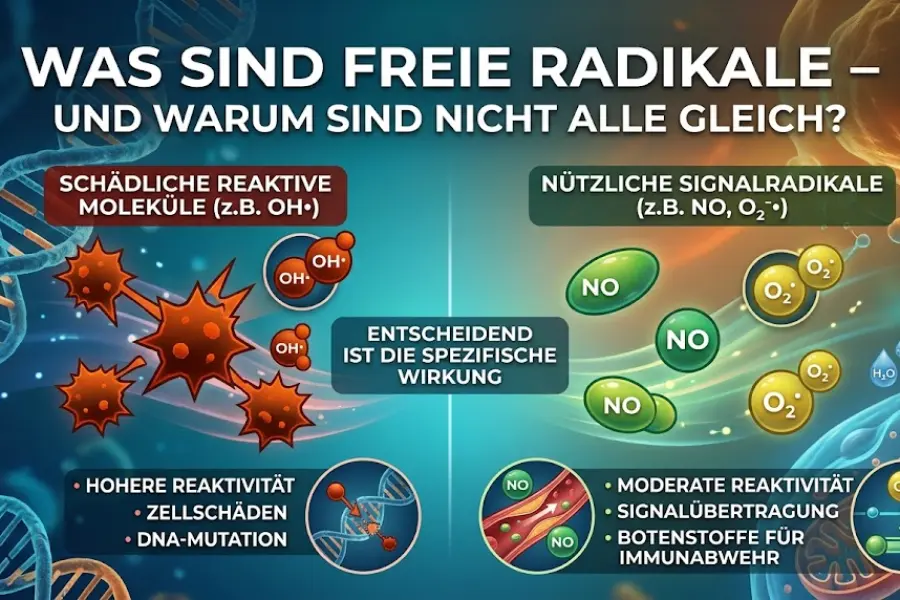
What are free radicals – and why are they not all the same?

The body continuously produces so-called reactive oxygen species (ROS) – highly reactive molecules with one or more unpaired electrons. They arise as a natural by-product of metabolism, above all in the mitochondria, but also through external factors such as stress, lack of sleep, environmental pollution, UV radiation or intense physical activity.

The popular image of free radicals as inherently “bad” and in need of complete neutralisation is now considered outdated in research. The actual picture is more nuanced:

Not all ROS are harmful. Many of them perform important tasks at normal concentrations. Superoxide anions, hydrogen peroxide and nitric oxide are regarded as significant signalling molecules. They are involved in regulating the immune system, in growth processes, in wound healing and in blood pressure regulation. Switching these molecules off indiscriminately would throw important bodily processes out of balance.

This is exactly where a much-discussed criticism of classic antioxidants begins.

To understand why selectivity is so central, it is worth looking at the fundamentals.

To understand why selectivity is so central, it is worth looking at the fundamentals.

The core problem with classic antioxidants: no differentiation

Classic antioxidants such as vitamin C or vitamin E react with a broad spectrum of ROS – with the potentially harmful ones as well as the useful ones. Taken through a balanced diet, this is unproblematic and part of a normal equilibrium.

The topic is mainly debated in connection with high-dose dietary supplements: in some clinical investigations, high-dose isolated antioxidants produced surprisingly neutral or inconsistent results – a finding that is still being discussed among experts today. One possible explanation cited in the literature: if ROS are captured indiscriminately, useful signalling processes may be affected as well.

In short, classic antioxidants act chemically more like a lawnmower – they do not strongly distinguish between harmful and useful molecules. And it is precisely at this point that molecular hydrogen becomes interesting for research.

The key study: Nature Medicine (2007)

In 2007, a Japanese research group led by Prof. Shigeo Ohta published a paper that gave the field of hydrogen research enormous momentum. It appeared in Nature Medicine, one of the most renowned medical journals in the world, and has since been cited more than 2,400 times in the scientific literature:

Ohsawa et al. (2007): “Hydrogen acts as a therapeutic antioxidant by selectively reducing cytotoxic oxygen radicals” – Nature Medicine, Vol. 13, pp. 688–694. DOI: 10.1038/nm1577

The study’s central observation: in the models investigated, molecular hydrogen reacted selectively – preferentially with the particularly reactive, purely destructive radicals, while the biologically important signalling molecules remained largely untouched. This selectivity is the core of what distinguishes H₂ from many classic antioxidants.

The chemistry behind the selectivity

Why does hydrogen react only with the most dangerous radicals of all? The answer lies in chemistry and is less mysterious than it sounds.

The body contains various ROS that differ markedly in their reactivity. At the extreme end of the spectrum sits the hydroxyl radical (•OH) – the most aggressive of these molecules. It reacts with almost anything it encounters: it can attack DNA strands, alter proteins and damage cell membranes. It has no meaningful biological signalling function; it is considered purely destructive. Similarly reactive is peroxynitrite (ONOO⁻), which also ranks among the strongest oxidants in the human body.

Molecular hydrogen reacts preferentially with exactly these highly reactive molecules. The reaction with the hydroxyl radical is thermodynamically favoured and therefore takes place preferentially:

H₂ + •OH → H₂O + H•

The result of this reaction is remarkably unspectacular – and that is precisely the point: a highly reactive radical simply becomes water. No toxic residue, no problematic by-product.

With the less reactive but biologically important ROS such as superoxide, hydrogen peroxide or nitric oxide, by contrast, H₂ barely reacts at all – simply because the reaction energy required is not sufficient. The selectivity is therefore not an arbitrary property but a consequence of fundamental chemical laws: H₂ is chemically “mild” enough to attack primarily the strongest oxidants without intervening heavily in other processes.

Why the molecular size of H₂ matters

Another aspect frequently mentioned in research is the size of the molecule. Hydrogen is the smallest molecule there is. Laboratory investigations show that it can easily penetrate biological membranes – a characteristic that larger molecules lack.

This property is interesting because it allows H₂ to distribute freely in tissue and also reach areas that are difficult for many larger molecules to access. In the specialist literature, this is discussed as one of the reasons why molecular hydrogen receives so much attention as a subject of research in the first place.

H₂ as a signalling molecule: what else research is investigating

More recent work suggests that the role of molecular hydrogen could extend beyond merely capturing radicals. In particular, researchers are investigating whether H₂ influences certain cellular signalling pathways. Three of them are frequently named in the literature:

  • Nrf2 pathway – considered a central regulator of the body’s own antioxidant response and controls the formation of various protective enzymes.

  • AMPK pathway – plays a role in cellular energy metabolism.

  • MAPK pathway – is involved, among other things, in the control of inflammatory responses.

Important for context: these relationships are the subject of current basic research. They describe possible mechanisms of action at the cellular level that are being investigated in laboratory and animal models as well as in initial clinical studies – and are not to be understood as established statements about everyday human life.

A vivid image often used in science communication: a classic antioxidant can be compared to a fire extinguisher that intervenes reactively. In research, molecular hydrogen is viewed more as a system that acts at several points at once – a comparison that explains the fascination among researchers, but which is expressly a model and not a promise of efficacy.

Hydrogen vs. classic antioxidants at a glance

Characteristic

Classic antioxidants (e.g. vitamin C, E)

Molecular hydrogen (H₂)

Reaction behaviour

reacts with a broad spectrum of ROS

reacts preferentially with highly reactive radicals

Selectivity

low

pronounced (a focus of research)

Molecule size

larger molecules

smallest molecule of all

Reaction product

various products

predominantly water (H₂O)

Signalling pathway research

partially investigated

Nrf2 / AMPK / MAPK are being investigated

The table summarises chemical properties and research priorities and is not to be understood as a statement about health effects.

Frequently asked questions (FAQ)

Molecular hydrogen consists of two hydrogen atoms and is the smallest and lightest molecule. In research it is investigated, among other things, as a potential selective antioxidant.

Conclusion: what selectivity means scientifically

Molecular hydrogen differs in its chemical basis from many classic antioxidants. The central, scientifically investigated point is its selectivity: in studies, H₂ reacts preferentially with the particularly reactive radicals such as the hydroxyl radical – and in doing so predominantly forms water. Its small molecular size and possible effects on cellular signalling pathways make it a fascinating subject of research.

It is precisely this combination that explains why molecular hydrogen has been investigated in more than 1,000 scientific studies and why research in this field continues to grow. Anyone interested in the background will find further information in the sources listed below.

Sources:
  • Ohsawa et al. (2007): Hydrogen acts as a therapeutic antioxidant by selectively reducing cytotoxic oxygen radicals. Nature Medicine, Vol. 13, 688–694. DOI: 10.1038/nm1577

  • Ying et al. (2025): Medicine, 104(10). DOI: 10.1097/MD.0000000000041800

  • Ohta, S. (2012): Recent Progress Toward Hydrogen Medicine. Current Pharmaceutical Design, 17(22).

Legal notice: This article serves exclusively as general scientific information. It describes results and mechanisms from research into molecular hydrogen and does not replace medical or nutritional advice. No health-related efficacy claims within the meaning of the NHCR (Regulation (EC) No 1924/2006) or disease-related claims within the meaning of the German Medicines Advertising Act (HWG) are made.