
AWAKE Hydrogen Water vs. Energy Drinks: The Big Comparison
Grab the quick caffeine kick from a can or bet on molecular hydrogen? We show what really happens in your glass – chemically, physiologically and health-wise.
>11
PPM
0
Sugar
100%
Pure

0
PPM
60g
Sugar
?
Pure
What is the difference between AWAKE and Energy Drinks?
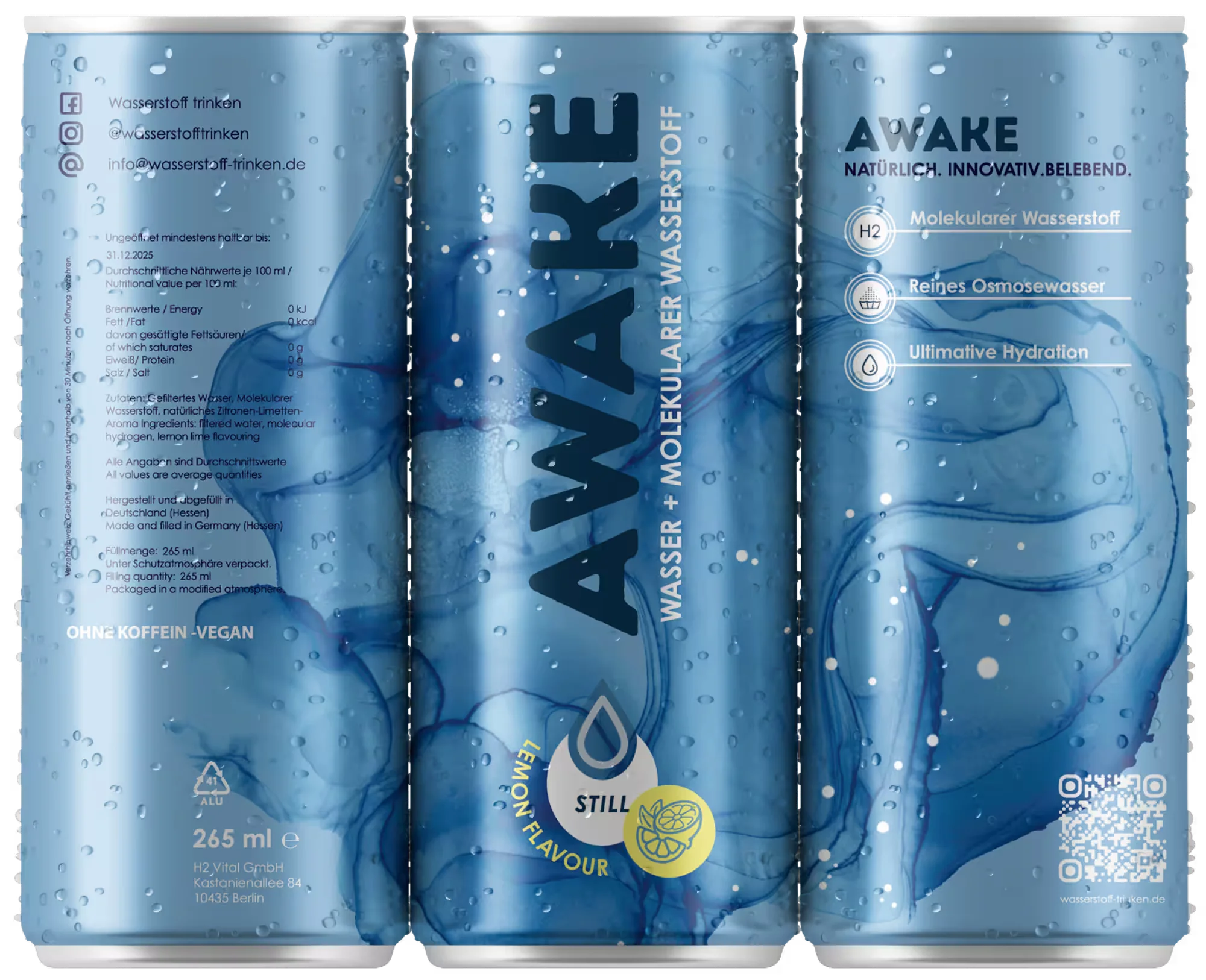
AWAKE is ready-to-drink hydrogen water with over 11 PPM of molecular hydrogen, filled under pressure in a BPA-free can or glass bottle. It delivers improved hydration and selective antioxidant properties – completely without sugar, calories or stimulants.
Energy drinks are highly processed beverages that primarily rely on the stimulating effect of caffeine, large amounts of sugar (or artificial sweeteners) and additives like taurine. They are meant to keep you awake short-term, but are criticized for health risks.
The decisive difference lies in three factors: Ingredients (AWAKE is 100% pure, energy drinks are chemically complex), Mode of action (AWAKE uses H₂, energy drinks force wakefulness through caffeine) and Health aspect (AWAKE is free of side effects, energy drinks carry risks with high consumption).
Why do people drink hydrogen water instead of energy drinks?
The answer lies not in a short-term 'sugar high', but in the sustainable chemistry of the molecule itself. Molecular hydrogen (H₂) is the smallest molecule occurring in nature. This extreme tininess is its decisive advantage – and the reason why biomedical research has published more than 3,000 publications on H₂ worldwide since the groundbreaking study by Ohsawa et al. (2007) in Nature Medicine. But what makes H₂ so interesting compared to artificial stimulants? It's about a problem that affects every body: oxidative stress.
The Problem: Free Radicals & Oxidative Stress
During normal metabolism, reactive oxygen species (ROS) are constantly produced – also known as free radicals. In small amounts, they are useful: the immune system needs them to fight pathogens. But when production gets out of control – due to stress, exercise, environmental toxins, lack of sleep or an unhealthy lifestyle – oxidative stress occurs. Cells, proteins and DNA can be damaged.
The Property of H₂: Selective, Small, Neutral
This is where the scientific interest in molecular hydrogen lies. H₂ is described in research as a selective antioxidant: it preferentially reacts with the most aggressive free radical – the hydroxyl radical (·OH) – without touching useful signaling ROS. The only reaction product is water. Due to its extremely small size, H₂ can also passively penetrate biological membranes, mitochondria and potentially even the blood-brain barrier – without transporters, without detours.
Important note: The research on molecular hydrogen is promising, but not yet conclusive. H₂ is not a medicinal product and no healing promises can be derived.
Energy Drinks: What's really inside?
When someone buys an energy drink, they are often looking for a quick energy boost. But the price for that is a massive burden on the body. A typical 500 ml can of an energy drink contains about 160 mg of caffeine and up to 60 grams of sugar – that's roughly 20 sugar cubes. This combination leads to a rapid rise in blood sugar levels and artificial stimulation of the nervous system.
In addition to sugar and caffeine, these drinks often contain acidifiers like citric acid, which can attack tooth enamel, as well as taurine, glucuronolactone and artificial flavors. As soon as the effect of the caffeine wears off and blood sugar levels drop rapidly, many consumers experience the notorious 'crash': they feel more exhausted and tired than before.
What makes energy drinks problematic in practice
Regular consumption of energy drinks carries significant health risks, which consumer protection agencies and medical professionals warn against.
Cardiovascular Strain
Excessive consumption of energy drinks can heavily strain the cardiovascular system. Possible consequences include high blood pressure, heart palpitations and in severe cases even cardiac arrhythmias. Studies suggest that even acute consumption in children and adolescents can lead to negative effects on cardiovascular function.
Sleep Disorders and Nervousness
The high-dose caffeine blocks fatigue receptors in the brain. This can lead to nervousness, inner restlessness, sweating and massive sleep disorders. A vicious cycle emerges: you sleep poorly, are tired the next day and reach for the energy drink again.
Overweight and Tooth Decay
The enormous sugar content (often over 10 g per 100 ml) promotes the development of overweight and diabetes. In combination with added acidifiers, an extremely caries-promoting environment is created in the oral cavity.
AWAKE: Hydrogen Without Compromises
To avoid the health disadvantages of energy drinks, AWAKE offers a completely different approach to the topic of refreshment and well-being – with pure water, molecular hydrogen and zero chemical additives.

Pressure Filling: >11 PPM through enormous partial pressure
Under extreme pressure, pure hydrogen gas is pressed directly into the water. The result: over 11 PPM of molecular hydrogen – a multiple of what is achievable with tablets in an open glass. AWAKE maintains this PPM concentration constantly until the can is opened.
Nanobubble Technology: Stably dissolved, not degassed
Nanobubble technology creates tiny gas bubbles that enormously increase the surface area of hydrogen in the water. This keeps H₂ stably bound in solution, instead of immediately degassing again – the key to stable concentration.
100% Purity: No sugar, no caffeine, no crash
AWAKE contains exclusively purest water and pure molecular hydrogen – in the can rounded off with 100% natural lemon-lime flavor. There is no sugar crash, no artificial stimulation and no chemical additives.
Diffusion-tight Packaging: BPA-free can or glass bottle
Hydrogen diffuses through plastic faster than any other gas. AWAKE is exclusively filled in 100% BPA-free aluminum cans or glass bottles – diffusion-tight, with overpressure that keeps the PPM concentration stable until opening.
AWAKE vs. Classic Energy Drinks: A Direct Comparison of Criteria
AWAKE
Constant >11 PPM through pressure & nanobubbles.
Comparison
0 PPM – no dissolved H₂ gas contained.
AWAKE
0 mg (completely caffeine-free).
Comparison
approx. 32 mg / 100 ml (often 160 mg per can).
AWAKE
0 g.
Comparison
Up to 12 g / 100 ml (approx. 60 g per can).
AWAKE
Water, H₂ gas, natural flavor.
Comparison
Water, sugar, caffeine, taurine, acidifiers.
AWAKE
Hydration & selective antioxidant (H₂).
Comparison
Artificial stimulation of the nervous system.
AWAKE
No negative after-effects.
Comparison
Often 'crash' (exhaustion) after effect wears off.
What our customers say
Over 3,000+ satisfied customers already trust the power of AWAKE.
“Since I've been drinking AWAKE regularly, it has become a firm part of my daily routine and I feel very comfortable with it in everyday life.”
Sarah M.
“I deal with health topics professionally and find the approach behind molecular hydrogen really exciting. Above all, the high H₂ concentration made me curious.”
Dr. Martin B.
“I've wanted to find something that integrates easily into everyday life for a long time. Meanwhile, several people at our home drink AWAKE regularly.”
Lisa W.
“My training volume has improved. Not in an unnatural way, but a sustainable increase in performance. Recovery after sports has become significantly better.”
Michael R.
“Tastes pleasant and is simply practical for on the go. I usually always have a few cans in the car or in my bag.”
Henrik P.
“Since I've been drinking AWAKE regularly, it has become a firm part of my daily routine and I feel very comfortable with it in everyday life.”
Sarah M.
“I deal with health topics professionally and find the approach behind molecular hydrogen really exciting. Above all, the high H₂ concentration made me curious.”
Dr. Martin B.
“The only drink that makes me noticeably feel better – and daily. I started about two months ago and have definitely noticed an increase in energy and focus. It also tastes great. I've already recommended it to several friends and can't wait to try the glass bottle next!”
Thomas K.
“I've been drinking AWAKE regularly for several months now. Especially in stressful everyday life, I automatically reach for it.”
Anna S.
“I've wanted to find something that integrates easily into everyday life for a long time. Meanwhile, several people at our home drink AWAKE regularly.”
Lisa W.
“My training volume has improved. Not in an unnatural way, but a sustainable increase in performance. Recovery after sports has become significantly better.”
Michael R.
“Tastes pleasant and is simply practical for on the go. I usually always have a few cans in the car or in my bag.”
Henrik P.
“I've been drinking AWAKE for 60 days now and am really satisfied with the results. The taste is great, the quality feels premium, and the balance is perfect for daily use. What really stands out is the customer service.”
Julia F.
Frequently Asked Questions in Comparison
Everything you need to know about AWAKE and energy drinks – answered concisely.
AWAKE is not a wake-up drink in the classic sense. It contains no caffeine and does not artificially stimulate the nervous system. However, many users report that through optimal hydration and the supply of H₂ they feel naturally more awake and focused, without the negative effects of an energy drink.
The high content of sugar and caffeine in combination with acidifiers strains the cardiovascular system, promotes tooth decay and can lead to sleep disorders, nervousness and in the long term to overweight.
Yes. In contrast to energy drinks, which according to consumer protection agencies are not recommended for children and adolescents and for which sales bans to minors are even demanded, AWAKE contains only water and hydrogen gas and is completely harmless.
PPM stands for 'Parts per Million' and indicates how much molecular hydrogen (H₂) is dissolved in the water. The higher the PPM value, the more H₂ is contained in the water. AWAKE maintains constantly over 11 PPM thanks to pressure filling – until the can is opened.
Yes. Since the study by Ohsawa et al. (2007) in Nature Medicine, over 3,000 publications on molecular hydrogen have been published worldwide. The research is promising, but not yet conclusive. H₂ is not a medicinal product and no healing promises can be derived.
Experience the
AWAKE Effect
AWAKE – the hydrogen drink with >11 PPM, no caffeine, no sugar.
- >11 PPM hydrogen concentration via nanobubble technology
- No caffeine, no sugar, 100% pure
- In glass & can – no PET, maximum stability
- No chemical residues, no additives
Scientific Basis
All statements about the effect of molecular hydrogen and the ingredients of energy drinks are based on peer-reviewed research and reputable sources.
Ohsawa I. et al. (2007). Hydrogen acts as a therapeutic antioxidant by selectively reducing cytotoxic oxygen radicals. Nature Medicine
View SourceConsumer Advice Centre (2025). Energy Drinks: Health Risk for Heavy Consumers. consumeradvicecentre.de
View SourceGerman Heart Foundation. Energy Drinks – a Risk for the Heart? heartfoundation.de
View SourceNote: The statements about the effect of molecular hydrogen are based on current, promising scientific research. However, H₂ is not a medicinal product. The state of research is not yet conclusive and no healing promises can be derived.